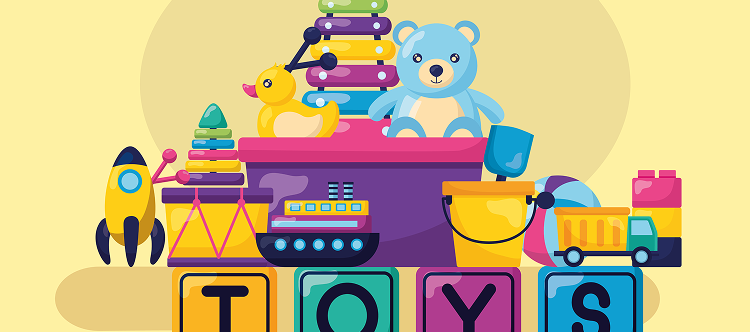
Sometimes… It Means More Confusion
Many parents say:
"My child has so many toys, but still doesn't play properly."
"Gets bored easily and cries over small things."
This is very common — and the problem is often not the child, but the environment.
What Brain Science Says
When children see too many toys at once, their brain receives multiple signals:
- "Choose me"
- "Look at me"
- "Don't ignore me"
This creates decision fatigue — the mental overload caused by too many choices.
Young children struggle because their prefrontal cortex (the brain area responsible for attention, decision-making, and emotional control) is still developing.
Research from UK child-development studies and neuroscience consistently shows:
- Too many choices increase stress
- Fewer choices improve focus and emotional regulation
The Simple, Science-Backed Solution: The Rule of Three
The Rule of Three:
Keep only 1–3 toys available at a time.
After a week or two:
- Rotate one toy out
- Introduce another from storage
This method:
- Improves attention
- Encourages deep, imaginative play
- Reduces frustration and emotional outbursts
This approach is supported by:
- UK early-years guidance (EYFS principles)
- Cognitive load theory
- Child neuroscience research on attention and executive function
Why Fewer Toys Work Better
With fewer toys:
- Children explore one toy more deeply
- Creativity increases
- Problem-solving skills improve
- Play becomes joyful again — not stressful
Importantly, this avoids unhealthy dopamine-driven overstimulation, which is increasingly discussed in modern child psychology.
Don't Forget the Play Environment
A healthy play space should be:
- Calm
- Uncluttered
- Low-noise
- Softly lit
A calm environment helps the nervous system settle — and only a calm brain can learn well.
A Message for Parents
Having many toys does not mean better parenting.
Better parenting means:
- Thoughtful choices
- Fewer distractions
- More meaningful play
Children don't need more toys.
They need:
- A calm brain
- Deep play
- Emotional balance
NeuroLearn AI Perspective
At NeuroLearn AI, we focus on how children learn, not how much stimulation they receive.
Especially for children with:
- Maths anxiety
- Learning difficulties
- Attention challenges
Less cognitive overload = better learning outcomes.
Because in a child's world:
Less is not less.
Less is more.